


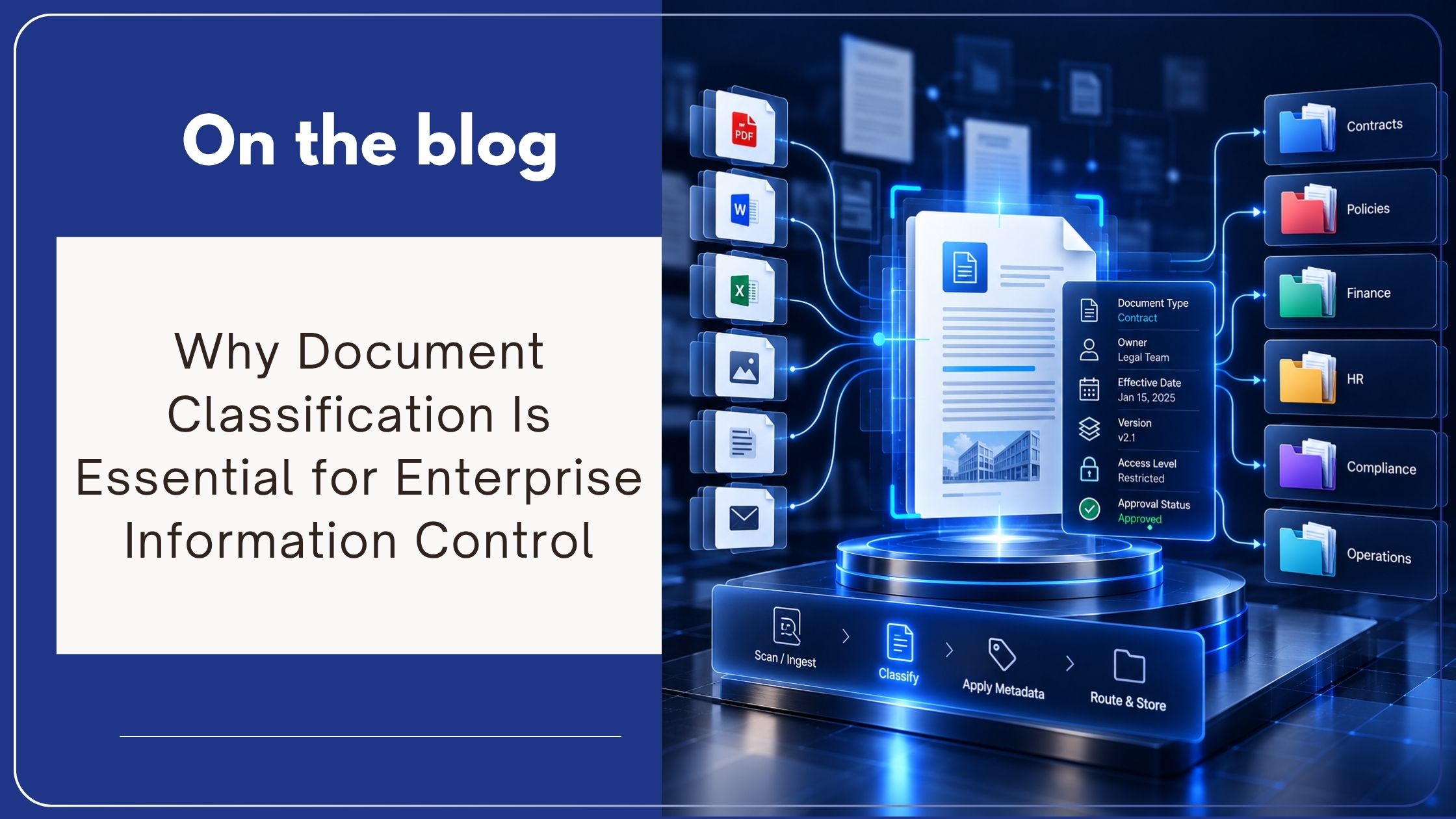
Why Document Classification Is Essential for Enterprise Information Control
A document cannot be governed correctly until the organization knows what it is.
An invoice, contract, employee record, customer application, quality report, and policy require different owners, metadata, access permissions, workflows, retention rules, and approval requirements. When documents are classified inconsistently, those controls become inconsistent as well.
Document classification is therefore not an administrative filing task. It is the decision that determines how enterprise information will be processed, protected, retrieved, retained, and used.
What Is Document Classification?
Document classification is the structured process of identifying a document according to its type, purpose, business context, or governance requirements.
A document may be classified as an invoice, purchase order, contract, personnel record, insurance claim, patient record, standard operating procedure, engineering drawing, regulatory submission, or another defined category.
Once the document type is established, the organization can apply the appropriate metadata, ownership, access controls, workflow, retention schedule, and lifecycle rules.
Classification answers the first operational question: What is this document?
Every subsequent control depends on the accuracy of that answer.
Classification Is Not the Same as Filing
Filing determines where a document is stored. Classification determines how the document should be treated.
A contract placed in a customer folder remains poorly controlled if the organization cannot identify its owner, approval status, effective date, confidentiality level, renewal requirement, or retention category.
Folder structures alone rarely provide enough context for enterprise information management. The same document may relate to a customer, department, project, legal entity, process, and regulatory requirement simultaneously.
Document classification establishes a consistent business identity that remains with the document regardless of where it is accessed or which process uses it.
This distinction becomes critical as information moves across departments, workflows, integrations, and enterprise systems.
Misclassification Creates Operational Exposure
Incorrect classification does more than make documents difficult to find.
A misclassified record may receive the wrong access permissions. A contract may bypass the required approval workflow. A compliance document may follow an incorrect retention schedule. An invoice may be routed to the wrong department. An outdated procedure may appear alongside current operational instructions.
Each failure originates from the same control weakness: the organization has not established what the document is and which rules apply to it.
In regulated and process-intensive organizations, these errors weaken accountability. Teams cannot consistently demonstrate that sensitive information was protected, required approvals occurred, or records were retained according to established policy.
Classification quality directly affects the reliability of downstream governance.
Classification and Metadata Perform Different Roles
Document classification and metadata are closely connected, but they are not interchangeable.
Classification identifies the document category. Metadata describes the document within that category.
For example, classifying a file as a contract establishes its document type. Metadata then identifies the customer, contract owner, effective date, expiration date, approval status, confidentiality level, and related business unit.
The classification determines which metadata fields are required. An invoice requires vendor, invoice number, purchase order, amount, and payment status. An employee record requires different information and different access controls.
As discussed in Why Metadata Matters More in the Age of Enterprise AI, structured metadata gives enterprise information its operational context. Classification provides the framework within which that context is applied consistently. computhink.com
Classification Determines Workflow Routing
Documents enter the organization because an action must occur.
An invoice requires validation and approval. A contract requires review. A customer application requires assessment. A policy requires approval and controlled distribution. A quality exception requires investigation and closure.
Correct document classification connects incoming information with the appropriate business process.
When the document type is known, workflow rules can direct it to the correct employees, apply the required approval sequence, establish responsibility, and maintain visibility into its status. Incorrect classification sends the document into the wrong process or leaves employees dependent on manual routing.
This is why classification must occur early. Business process automation becomes unreliable when the information entering the process lacks a defined identity.
Access Control Depends on Information Context
Organizations cannot govern access consistently when documents are treated as undifferentiated files.
Employee records, financial information, customer data, legal documents, healthcare records, intellectual property, and operational instructions require different levels of protection. Classification provides the business context required to apply appropriate permissions.
A document classified as a personnel record should not inherit the same access rules as a public policy. A confidential contract should not be available through the same access structure as a general sales template.
Classification-based control reduces unauthorized access while ensuring that employees with legitimate responsibilities can retrieve the information required for their work.
Without consistent classification, access decisions become dependent on folder locations, filenames, or individual judgment. None provides a dependable enterprise control framework.
Records Retention Starts With Classification
Retention requirements differ according to the type and purpose of a record.
A financial record, employment document, customer agreement, quality report, and temporary working file do not necessarily share the same retention period or disposition requirement. The organization must first identify the record category before the correct lifecycle rule can be applied.
Poor classification leads to two forms of exposure. Records may be disposed of before the approved retention period ends, or obsolete information may be retained longer than business and policy requirements justify.
Accurate classification connects documents with defined review, archival, retention, and disposition rules. It turns records governance into a repeatable process rather than a manual decision made at the end of the document lifecycle.
Enterprise AI Increases the Importance of Classification
Enterprise AI can read document content without reliably understanding its authority or business purpose.
A signed agreement, expired contract, working template, and unapproved draft may contain similar terminology. Without classification and metadata, an AI search or retrieval system may treat all four as equivalent sources.
Classification helps distinguish current operational information from reference material, records from drafts, and authoritative documents from templates. It gives search and AI systems stronger context for determining which information is relevant to a request.
AI does not eliminate the requirement for document structure. It increases the consequences of weak structure by making poorly classified information easier to retrieve and reuse at scale.
Classification Requires Governance Standards
Document classification fails when every department creates its own categories or employees apply labels according to personal interpretation.
Organizations need a controlled classification framework that defines:
- Approved document types and categories
- Required metadata for each document type
- Ownership of classification standards
- Access and workflow rules connected to each category
- Retention requirements
- Exception handling and validation
- Periodic review of classification structures
These standards should reflect how the organization operates rather than reproduce an uncontrolled folder hierarchy.
Classification governance also requires accountability. Someone must own the taxonomy, approve changes, resolve ambiguity, and ensure that new document types do not create duplicate or conflicting categories.
How Contentverse Supports Structured Document Classification
Contentverse provides a centralized, organized environment where document types, metadata, indexing, access permissions, workflows, and records controls operate as connected parts of information governance.
Organizations can define metadata fields for different document types and use indexed attributes to organize and retrieve information. Easy Index supports high-volume document organization using technologies such as OCR, barcodes, regular expressions, and database lookups. The Automated Input Processor uses document metadata to automatically file and index incoming content while holding exceptions separately for validation. computhink.com
Using Contentverse, classification becomes more than a label. It establishes the structure through which documents are indexed, secured, routed, searched, validated, and retained.
This supports greater consistency while preserving human review where incoming information does not meet established criteria.
Information Control Begins With Correct Classification
Organizations cannot apply reliable governance to information they have not identified correctly.
Classification determines what a document represents, which context it requires, who should access it, which process should receive it, and how its lifecycle should be controlled.
As document volumes increase and enterprise automation expands, inconsistent classification creates wider operational exposure. Errors move faster, search results become less reliable, and governance rules become harder to enforce.
Correct classification establishes the foundation for consistent information control.
Explore how Contentverse connects document classification with metadata, workflow, access control, search, and records governance.
FAQ / People Also Ask
What is document classification in document management?
Document classification identifies a document according to its type, purpose, or business context so that the correct metadata, permissions, workflow, and lifecycle rules can be applied.
Why is document classification important?
Classification determines how documents are organized, protected, routed, retrieved, and retained. Incorrect classification weakens every downstream control that depends on the document type.
What is the difference between document classification and metadata?
Classification identifies what the document is. Metadata describes the document through attributes such as owner, customer, approval status, effective date, or retention category.
How does document classification support workflow automation?
Classification connects a document with the appropriate workflow. It determines which employees receive it, which approvals are required, and what actions must occur next.
How does document classification improve enterprise search?
Classification allows search systems to distinguish between different document types and narrow results according to business context, status, ownership, or purpose.
Why does enterprise AI require classified documents?
Classification gives AI retrieval systems context about document type and authority. It reduces the risk of treating drafts, templates, expired records, and approved documents as equivalent sources.
How does Contentverse support document classification?
Contentverse connects document types and metadata with indexing, search, workflow, permissions, automated filing, exception validation, and records controls within a centralized information environment.