


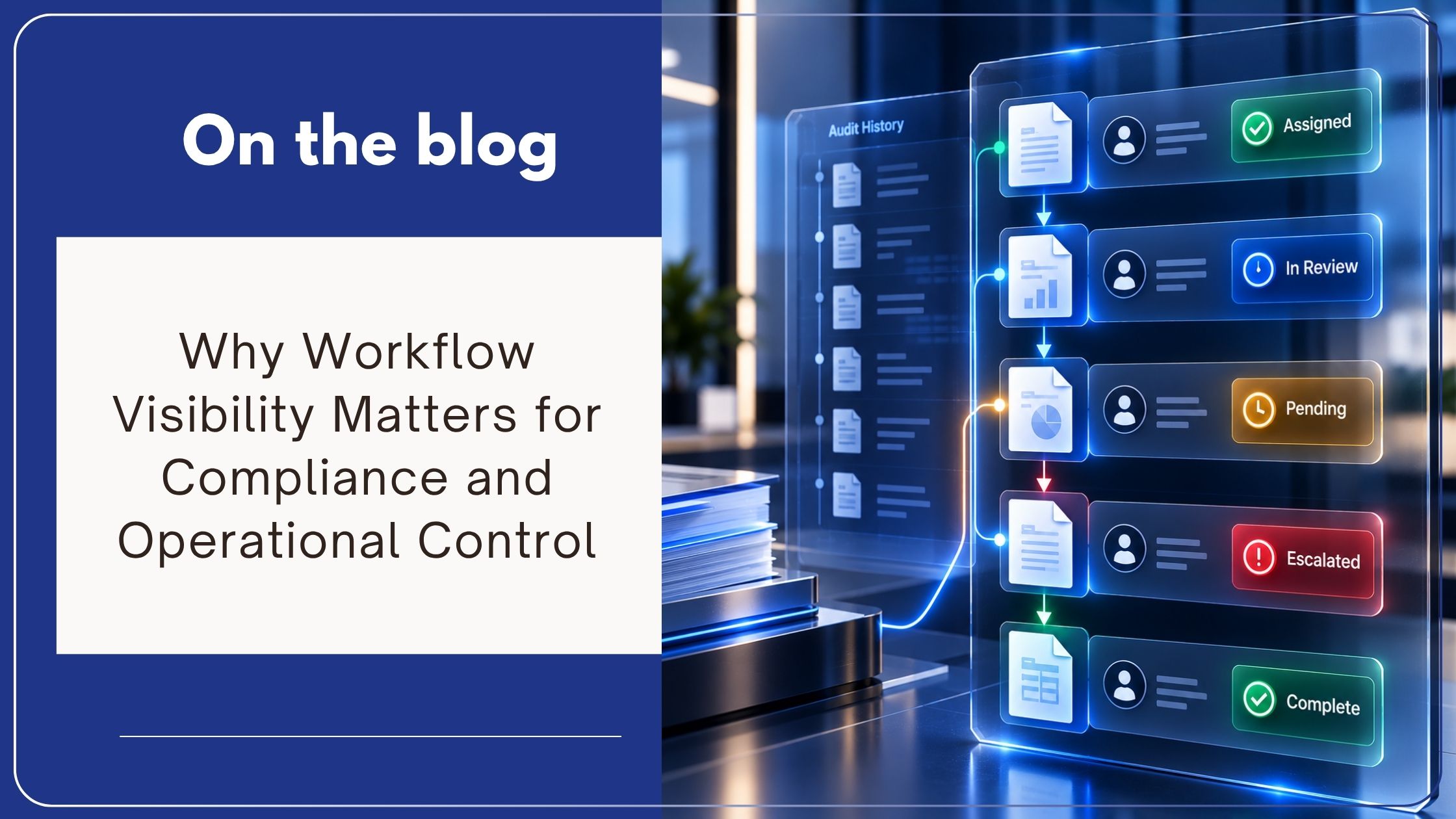
Why Workflow Visibility Matters for Compliance and Operational Control
A process cannot be controlled if its current status cannot be verified.
Organizations often know when a workflow begins and when the final document appears. What happens between those points can remain hidden across inboxes, spreadsheets, verbal follow-ups, and disconnected systems.
That lack of workflow visibility creates more than an efficiency problem. It prevents leaders from determining who owns the next action, which approvals remain pending, whether deadlines are approaching, where exceptions exist, and whether the required process was followed.
Operational control requires visibility throughout execution, not only confirmation after completion.
What Is Workflow Visibility?
Workflow visibility is the ability to determine the current status, ownership, history, and required next action within a business process.
It should allow authorized users and process owners to answer questions such as:
- Which stage has the process reached?
- Who currently owns the required action?
- What has already been completed?
- Which approval remains pending?
- Is an action approaching or exceeding its deadline?
- Has an exception occurred?
- Was an overdue action escalated?
- Can the complete process history be verified?
This visibility must extend beyond a general progress indicator. A process marked “in progress” provides little operational value if no one can determine what is pending or who must act.
Effective visibility connects process status with identifiable responsibility.
Status Uncertainty Creates Operational Exposure
When workflow status is difficult to determine, employees spend time reconstructing the process.
They search through email chains, contact colleagues, update spreadsheets, and compare document versions to establish what has occurred. Even then, the resulting status may be incomplete or outdated.
This uncertainty delays decisions and weakens accountability. A process owner cannot intervene when the point of delay is unknown. A manager cannot reassign work when ownership is unclear. A compliance team cannot confirm whether a required review occurred when the process history is fragmented.
The organization may eventually complete the process, but it cannot demonstrate that execution remained controlled throughout.
This creates operational exposure in approval-driven, regulated, and time-sensitive processes where the sequence of actions matters as much as the final outcome.
Compliance Requires Evidence of Execution
Compliance cannot depend solely on the existence of a final document.
Organizations may also need to demonstrate who reviewed the information, which version received approval, when the decision occurred, whether required controls were followed, and how exceptions were resolved.
A completed contract does not automatically prove that every required review occurred. An approved policy does not show whether the correct participants authorized it. A closed quality event does not establish how the investigation, assigned actions, and final approval progressed.
Workflow visibility creates the evidence required to understand process execution.
Audit trails and workflow histories can preserve:
- Task assignments
- Review and approval actions
- Dates and timestamps
- Document versions used during decisions
- Comments and annotations
- Reassignments
- Notifications and escalations
- Exception responses
- Final completion status
This traceability supports compliance and audit readiness without claiming that technology alone guarantees compliance. The platform provides structured evidence, while the organization remains responsible for defining and enforcing its requirements.
Visibility Must Begin With Governed Information
A visible process operating on uncontrolled information remains unreliable.
Approvers and reviewers need access to the correct document, current version, relevant metadata, and supporting records. If workflow participants rely on attachments or copies stored outside the governed environment, the process can appear controlled while decisions are based on inconsistent information.
Workflow visibility and information governance must therefore operate together.
The organization should be able to connect each action with the information that supported it. When a document is revised during the process, the version history should remain traceable. When access is restricted, workflow participation should not create an indirect route to unauthorized information.
This is why workflow management should not operate as a separate layer disconnected from enterprise document management. Process visibility becomes more reliable when tasks, actions, decisions, and status remain connected to governed information.
Ownership Must Remain Visible at Every Stage
Every pending action needs an identifiable owner.
A process becomes vulnerable when responsibility is assigned through informal communication or assumed based on departmental knowledge. Employees may believe another person is handling the task. Approvers may not recognize that action is required. Managers may discover the delay only after a dependent deadline has been missed.
Visible task ownership prevents work from becoming anonymous.
The process should show who currently owns the action, when it was assigned, when it is due, and what must happen next. If responsibility changes, the reassignment should become part of the process history.
As discussed in document workflow automation, controlled routing replaces informal handoffs with defined responsibility and traceable movement. Visibility then allows process owners to verify that the intended routing is functioning in practice.
Notifications and Escalations Turn Visibility Into Action
Visibility identifies the condition. Operational control requires a response.
A dashboard showing an overdue task does not resolve it. Someone must receive the notification, accept responsibility, and complete or escalate the action.
Automatic workflow notifications communicate when work has been assigned, when a deadline is approaching, or when another process event requires attention. Escalations direct unresolved actions to the appropriate supervisor, alternate approver, or process owner.
These mechanisms are especially important when a delay affects downstream operations. A pending contract review can postpone commercial activity. An unresolved invoice approval can affect supplier payment. A delayed quality action can prevent process closure.
The earlier discussion on proactive process control establishes the distinction clearly: visibility shows what requires attention, while control ensures that the required response is initiated.
Process Reporting Reveals Systemic Weaknesses
Individual workflow status supports immediate intervention. Reporting supports process improvement.
When workflow information is captured consistently, leaders can examine patterns across departments, process types, approval stages, and time periods. They can identify where work repeatedly stalls, which actions frequently become overdue, where exceptions concentrate, and whether escalation paths are effective.
This changes management from anecdotal reporting to evidence-based process oversight.
Instead of asking employees why a process feels slow, leaders can evaluate:
- Average completion time
- Time spent at each process stage
- Frequency of overdue actions
- Recurring exception types
- Reassignment patterns
- Approval delays
- Escalation volume
- Completion trends
These findings allow the organization to address process design, workload, authority, and resource issues that would otherwise remain hidden.
Reporting therefore supports more than productivity measurement. It provides evidence for strengthening operational control.
Visibility Supports Consistent and Predictable Execution
Processes become unpredictable when leaders cannot determine how work is progressing.
One request may move quickly because an employee knows whom to contact. Another may remain pending because its owner is unavailable. A third may bypass a review because the required sequence was not clearly enforced.
Workflow visibility exposes this variation.
When process owners can see stages, ownership, deadlines, exceptions, and completion histories, they can intervene before individual delays become recurring business disruptions. They can also compare actual execution with the intended process and identify where stronger controls are required.
This improves predictability because process outcomes no longer depend entirely on individual memory or manual coordination.
The objective is not simply to move every workflow faster. It is to execute business processes consistently, visibly, and accountably.
Contentverse Connects Information With Process Visibility
Contentverse brings governed information and controlled process execution together within an Information and Business Process Management Platform.
Documents and business information remain connected to workflow routing, assigned tasks, reviews, approvals, notifications, escalations, and process history. Authorized users can determine what action is required, who is responsible, what remains pending, and how the process progressed.
Workflow dashboards and reporting provide visibility into assigned work and current process status. Notifications alert users when action is required, while defined workflow paths direct documents to designated participants. Audit trails and version histories preserve evidence of document and user activity.
Contentverse identifies workflow as an integral platform capability and provides workflow dashboards, reporting, assigned task views, notifications, version histories, and audit trails to support process execution and oversight. computhink.com
These capabilities work together to support operational outcomes:
- Governed information gives participants a reliable basis for action
- Visible ownership establishes responsibility
- Workflow status identifies what has occurred and what remains pending
- Automatic notifications prompt timely action
- Escalations direct attention to unresolved exceptions
- Audit trails preserve traceable evidence
- Reporting helps leaders identify recurring process weaknesses
Using Contentverse, organizations can maintain visibility from the information that initiates a process through the actions, decisions, and outcomes that complete it.
Visibility Must Lead to Accountable Execution
Workflow visibility is valuable only when it supports timely intervention and accountable action.
A process owner should not have to wait for a complaint, missed deadline, or audit request to discover that work has stalled. The organization should be able to identify pending responsibilities, overdue actions, unresolved exceptions, and incomplete approvals while there is still time to respond.
This creates a clear operational progression:
Governed Information → Visible Process → Timely Intervention → Accountable Outcome
Compliance and operational control depend on knowing more than whether a process eventually finished. Organizations need evidence that the correct information moved through the required actions, that responsibility remained clear, and that exceptions received an appropriate response.
Visibility creates accountability when it remains connected to ownership, notifications, escalations, traceability, and action.
See how Contentverse connects governed information with visible and controlled business process execution.
FAQ / People Also Ask
What is workflow visibility?
Workflow visibility is the ability to see a process’s current stage, responsible owner, completed actions, pending tasks, exceptions, deadlines, and history.
Why does workflow visibility matter for compliance?
It provides traceable evidence of reviews, approvals, assignments, decisions, escalations, and completion. This helps organizations demonstrate how required processes were executed.
Is workflow visibility the same as workflow automation?
No. Workflow automation routes and coordinates work according to defined rules. Workflow visibility shows what is happening within that process, who is responsible, and where intervention is required.
What information should a workflow dashboard display?
A workflow dashboard should show assigned tasks, current status, pending actions, owners, deadlines, exceptions, overdue work, and relevant completion information.
How does workflow visibility strengthen accountability?
It connects each required action with an identifiable owner, expected timeframe, and traceable history. This makes incomplete or delayed work difficult to overlook.
Why are automatic notifications and escalations necessary?
Notifications tell users when action is required. Escalations direct unresolved or overdue work to the appropriate authority before delays spread into connected operations.
How does process reporting improve operational control?
Reporting reveals recurring bottlenecks, exception patterns, overdue stages, reassignment trends, and completion performance. Leaders can use this evidence to improve process design and accountability.
How does Contentverse support workflow visibility?
Contentverse connects governed documents with workflow routing, assigned tasks, approvals, notifications, process status, reporting, version histories, and audit trails within one controlled environment.