


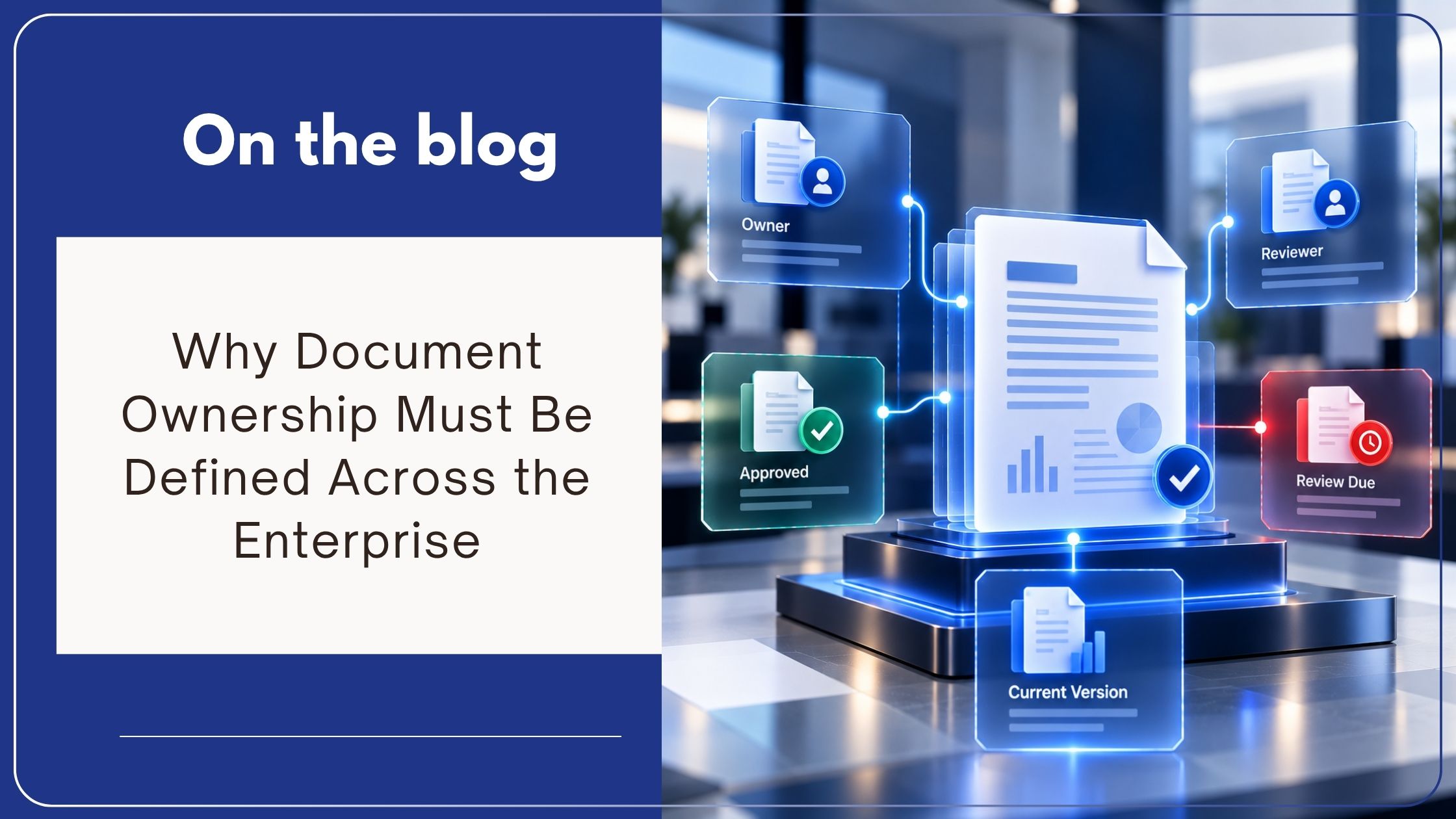
Why Document Ownership Must Be Defined Across the Enterprise
If nobody owns the document, nobody owns the risk.
Enterprise information becomes unreliable when responsibility for its accuracy, approval, protection, review, and retention remains undefined. A document may exist in a controlled repository, but without an accountable owner, no one is clearly responsible for determining whether it is current, authoritative, appropriately accessed, or still required.
Document ownership is therefore not an administrative detail. It is a fundamental requirement for information governance, operational control, and accountability.
What Is Document Ownership?
Document ownership is the formal assignment of responsibility for a document or defined category of information.
The owner is accountable for ensuring that the document remains accurate, current, appropriately classified, available to authorized users, and governed throughout its lifecycle.
Ownership does not necessarily mean that one person creates, edits, approves, and retains the document. Different participants may perform these actions. The owner remains accountable for ensuring that the required controls and actions occur.
For example, a policy owner may coordinate input from legal, compliance, operations, and executive management. The owner does not make every decision independently, but remains responsible for ensuring that the document is reviewed, approved, communicated, updated, and retained according to established requirements.
Storage Location Does Not Establish Ownership
Organizations often mistake document location for document ownership.
A file stored in a departmental folder does not automatically have an accountable owner. A document created by an employee should not become permanently dependent on that employee. A shared repository may control access without defining who is responsible for the information itself.
This creates a common governance gap: the organization knows where the document is stored but cannot determine who must maintain it.
The problem becomes more visible when:
- An employee changes roles or leaves
- A procedure requires review
- Conflicting versions appear
- An approval remains incomplete
- An access decision must be made
- A retention event occurs
- An audit requires evidence of authority
A centralized repository is essential, but centralization alone does not assign responsibility. Ownership must be defined as part of the document’s governance structure.
Ownership Establishes Information Authority
Employees need to know which documents they can rely on when making decisions.
When ownership is undefined, drafts, approved documents, templates, obsolete procedures, and reference copies can appear equally authoritative. Employees then depend on filenames, timestamps, folder locations, or informal confirmation to determine which information should guide action.
A designated owner is responsible for maintaining the document’s business authority. This includes coordinating approval, confirming the current version, initiating required updates, and identifying when the document should no longer remain active.
Ownership strengthens the single source of truth because information authority becomes assigned rather than assumed.
The organization can identify not only which document is current, but also who is accountable for keeping it current.
Document Owners and Process Owners Serve Different Roles
Document ownership and process ownership are closely connected, but they are not identical.
A document owner is accountable for the integrity, status, and governance of information. A process owner is accountable for how work moves through defined tasks, reviews, approvals, decisions, and outcomes.
In some cases, the same person holds both responsibilities. In others, ownership is divided.
For example, human resources may own an employee policy while operations owns the acknowledgement process. Legal may own a contract template while a commercial team owns the customer approval process. Quality may own a controlled procedure while a department manager owns its implementation.
The distinction must remain clear. Otherwise, the document owner may assume the process owner is maintaining the information, while the process owner assumes the document owner is monitoring execution.
Defined ownership prevents accountability from disappearing between information and process responsibilities.
Ownership Must Continue Throughout the Document Lifecycle
Responsibility should not end after a document is created or approved.
Documents move through creation, classification, review, active use, revision, record declaration, retention, archival, and disposition. Each stage requires an accountable decision.
The document owner should know when information requires review, whether its business purpose has changed, and who must authorize revisions. When responsibility transfers to another role or department, that transition should be deliberate and traceable.
This becomes particularly important during organizational change. Employees leave, departments are restructured, systems change, and responsibilities move. If ownership remains attached only to the original creator, documents become orphaned.
Orphaned documents remain available without anyone being responsible for their accuracy, access, retention, or continued relevance.
Undefined Ownership Weakens Version Control
Version control technology preserves revisions, but ownership determines which changes are necessary and which version should hold authority.
Without an accountable owner, outdated content can remain active because no one has responsibility for reviewing it. Several departments may create their own variations. Employees may revise local copies without coordinating approval.
The organization then possesses version history without effective version governance.
As explained in why version control failures create audit exposure, technical versioning must be supported by controlled review and approval. Ownership establishes who is accountable for initiating that process and confirming the authorized result.
Access Control Requires Business Accountability
System administrators can configure permissions, but they should not independently determine every business-access requirement.
The document owner understands the information’s sensitivity, purpose, audience, and operational context. That knowledge is necessary when determining who should view, edit, approve, export, or share the document.
Without defined ownership, access decisions can remain unchanged long after roles and business requirements have shifted. Employees may retain access they no longer require, while new participants may be unable to obtain information needed for legitimate work.
Ownership connects technical access control with business authority.
The owner does not replace information security or system administration. Instead, ownership provides accountable business direction for how permissions should be applied and reviewed.
Reviews Must Be Assigned, Not Assumed
Policies, procedures, templates, contracts, and operational instructions become outdated when periodic review depends on memory.
A controlled review process should identify the responsible owner, review frequency, required participants, approval authority, and action required when information is no longer accurate.
Automatic notifications can alert owners before a review becomes overdue. Escalations can bring unresolved actions to the appropriate authority. Workflow status allows governance teams to distinguish current documents from those awaiting review.
This converts document maintenance from an informal expectation into an accountable business process.
Review ownership also improves predictability. Leaders can determine which information is current, which documents are approaching review, and where delayed action is creating exposure.
Retention and Disposition Need Accountable Authority
The end of a document’s lifecycle requires ownership as clearly as its beginning.
Retention schedules establish how long records should remain available, but lifecycle events can require business judgment. A contract may remain relevant because of an unresolved dispute. A project record may require extended preservation. A legal or regulatory hold may prevent planned disposition.
Conversely, information should not remain indefinitely because no one is willing to authorize its disposition.
An accountable owner should participate in determining whether the document has completed its operational purpose and whether established conditions for archival or disposition have been satisfied.
This does not give an individual unrestricted authority to delete information. Disposition should follow defined retention policies, authorization requirements, and applicable holds. Ownership ensures that the business decision is not left unresolved.
Ownership Creates Traceable Accountability
Executives, auditors, compliance teams, and process owners need more than a document list. They need to understand who is accountable for information and what actions have occurred.
A governed ownership model should make it possible to determine:
- Who owns the document
- Who created or captured it
- Who reviewed and approved it
- Who changed it
- Which version is current
- When the next review is due
- Which retention requirements apply
- Who authorized its final lifecycle action
This traceability reduces dependence on personal knowledge and disconnected communications.
It also strengthens operational resilience. When employees change roles, responsibility can be reassigned without losing the history or business context of the information.
How Contentverse Supports Document Accountability
Contentverse provides a centralized, organized environment where documents, access rights, versions, workflows, actions, and audit information can remain connected.
Metadata and document classification can identify the department, business context, status, and responsible role associated with information. Version revision maintains a traceable history of changes. Configurable permissions support controlled access, while audit trails record user activity.
Workflow extends accountability into execution. Documents can be routed to designated participants for review, approval, or action. Notifications inform users when responsibility requires attention, while workflow reporting and task visibility make current status easier to verify. Contentverse documents these capabilities across its workflow, security, audit-trail, notification, version-revision, and reporting functionality. computhink.com
Using Contentverse, organizations can connect document responsibility with the actions required to keep information accurate, controlled, and operationally relevant.
The result is not ownership as a static metadata field. It is ownership supported by visible actions, defined authority, and traceable accountability.
Ownership Must Be Designed Into Governance
Document ownership should not be determined only when a problem occurs.
Organizations need an ownership model that defines responsible roles by document type, department, business process, or information category. It should establish how ownership is assigned, reviewed, transferred, and escalated when responsibilities change.
Without this structure, information governance remains incomplete. Documents can be secured without being maintained, retained without being reviewed, and accessed without anyone accepting responsibility for their continued authority.
Defined ownership closes that gap.
When every business-critical document has an accountable owner, the organization gains clearer authority, stronger lifecycle control, more consistent information quality, and greater operational predictability.
Evaluate where undefined document ownership is creating accountability gaps across your enterprise.
FAQ / People Also Ask
What is document ownership?
Document ownership is the formal assignment of accountability for maintaining a document’s accuracy, authority, classification, access, review, and lifecycle status.
Is a document owner always the document creator?
No. The creator produces or captures the document, while the owner remains accountable for its continued governance. Ownership can be assigned to another person, role, or department.
What is the difference between a document owner and a process owner?
A document owner is accountable for the information itself. A process owner is accountable for the tasks, decisions, approvals, and outcomes associated with a business process. The roles must coordinate when documents support process execution.
Why does undefined document ownership create risk?
Without an owner, required reviews can be missed, outdated versions can remain active, access rights can go unexamined, and retention decisions can remain unresolved.
Can document ownership be assigned to a role instead of a person?
Yes. Role-based ownership often provides greater continuity because accountability remains attached to a business function when individual employees change positions or leave the organization.
How should ownership be transferred when an employee leaves?
Ownership should be reassigned through a defined, traceable process. The transfer should preserve document history, status, permissions, pending actions, and upcoming review or retention requirements.
How does document ownership support version control?
The owner initiates required updates, coordinates review and approval, and confirms which version is authorized for current use. This turns version history into controlled version governance.
How does Contentverse support document accountability?
Contentverse connects metadata, permissions, versions, workflows, notifications, audit trails, and reporting so that information and related actions remain visible and traceable.