


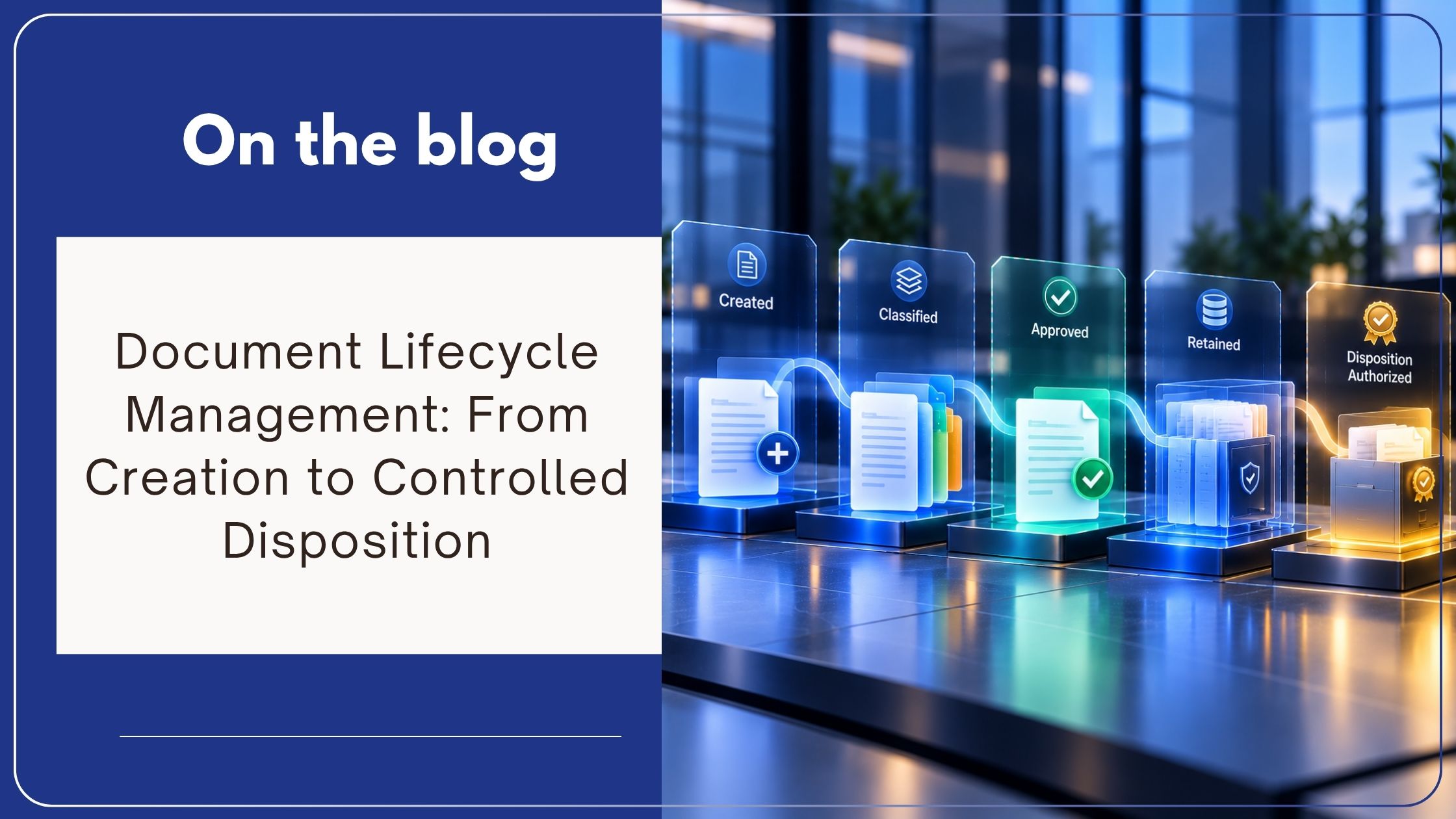
Document Lifecycle Management: From Creation to Controlled Disposition
A document creates operational value only when it remains controlled throughout its lifecycle.
Capturing information is the beginning, not the end, of document governance. Business documents are created, reviewed, approved, revised, used, retained, archived, and eventually disposed of. Every stage introduces decisions about ownership, access, accuracy, status, retention, and accountability.
When these stages are managed separately, organizations accumulate outdated versions, duplicate information, inactive records, inconsistent retention practices, and documents whose authority cannot be established.
Document lifecycle management creates a controlled path from creation through final disposition.
What Is Document Lifecycle Management?
Document lifecycle management is the structured control of information from the moment it is created or received until its authorized archival or disposition.
The lifecycle commonly includes:
- Creation or capture
- Classification and indexing
- Review and approval
- Active use and revision
- Record declaration
- Retention and protection
- Archival or controlled disposition
These stages are connected. Weakness at the beginning of the lifecycle creates uncertainty later.
A document captured without adequate classification becomes difficult to retrieve. A document revised without version control creates conflicting instructions. A record retained without an assigned schedule can remain indefinitely. A file deleted without authorization can remove required evidence.
Lifecycle governance establishes how information should be managed at each stage and who remains accountable for it.
Creation Must Establish Context and Ownership
Lifecycle control begins when information enters the organization.
Documents arrive through email, business applications, uploads, generated forms, integrations, and other sources. If they are stored without meaningful classification, the organization loses important context from the start.
A controlled creation or capture process should establish what the document is, which business activity it supports, who owns it, how it should be classified, and which controls apply.
Metadata connects the document with a customer, employee, vendor, case, contract, project, department, transaction, or other business context. Ownership establishes responsibility for its accuracy and continued relevance.
These controls prevent documents from becoming anonymous files that remain available but cannot be governed reliably.
Classification Determines What Happens Next
Different information requires different treatment.
A working draft should not be governed in the same way as an approved policy. A temporary reference file should not automatically receive the same retention requirements as an official business record. A confidential employee document requires different access controls from a public information sheet.
Document classification determines which metadata, permissions, workflows, retention schedules, and review requirements should apply.
Inconsistent classification creates lifecycle errors. Documents may be routed to the wrong process, made accessible to unauthorized employees, retained for the wrong period, or excluded from required reviews.
Classification therefore supports more than search. It directs how information should be controlled throughout its operational life.
Review and Approval Establish Authority
A document does not become authoritative simply because it has been created.
Contracts, policies, procedures, quality documents, financial records, employee documents, and other business-critical information frequently require review or approval before they can govern an action.
Controlled workflows connect the document with the people responsible for evaluating and authorizing it. Defined ownership establishes who must act. Automatic notifications communicate when action is required. Escalations address overdue reviews or approvals before delays affect downstream operations.
The approval history should remain connected to the document. This creates evidence of who reviewed the information, when authorization occurred, and which version received approval.
Without that connection, employees may find a final document but remain unable to demonstrate how it achieved its approved status.
Active Use Requires Version Integrity
Documents change as business conditions, regulations, customer requirements, products, and internal processes evolve.
During active use, employees must be able to identify the current authorized version. Uncontrolled copies stored in inboxes, shared drives, and local folders can continue circulating after the source document has changed.
This creates operational exposure. An outdated procedure can produce inconsistent work. A superseded specification can affect quality. An earlier contract version can influence an incorrect commercial decision.
As discussed in why version control failures create audit exposure, version integrity requires more than preserving previous copies. The organization must maintain an identifiable current version, a traceable revision history, and controlled access to superseded information.
Employees should work from a governed single source of truth rather than determine document authority through filenames or email timestamps.
Documents Become Records Through Business Activity
Not every document begins as an official record.
Documents often remain active while employees edit, review, and use them within business processes. Once a document provides evidence of a completed transaction, decision, approval, obligation, or activity, its governance requirements change.
The organization may need to protect the record from inappropriate alteration, apply a retention schedule, restrict access, and preserve its relationship with the process that created it.
The distinction between active documents and official records is addressed in records management versus document management. Both functions are essential because documents must remain usable during active work and defensible after they become records.
Record declaration should not depend solely on employees remembering to apply it. Defined rules, metadata, document types, and workflow outcomes should support consistent lifecycle transitions.
Retention Must Be Applied Systematically
Retention determines how long information should remain available and protected.
Without systematic control, organizations commonly retain too much information, dispose of records inconsistently, or depend on individual employees to interpret retention requirements.
Keeping everything indefinitely is not a defensible lifecycle strategy. Excessive retention increases information volume, complicates retrieval, and preserves sensitive content beyond its operational need. Premature deletion creates a different exposure by removing information that remains subject to business, legal, contractual, or regulatory requirements.
Retention schedules should align with document classification, business purpose, jurisdiction, and applicable organizational policies. Authorized holds or exceptions must prevent disposition when information remains relevant to an investigation, dispute, audit, or other defined requirement.
The objective is not indiscriminate deletion. It is controlled retention based on established authority.
Disposition Is a Governed Business Process
Final disposition is one of the most sensitive stages of the document lifecycle.
Records should not disappear because storage space is limited, an employee leaves, or someone considers them obsolete. Disposition must follow defined rules and authorized actions.
Before information is destroyed, the organization should be able to confirm:
- The applicable retention period has expired
- No hold or exception prevents disposition
- The correct records have been identified
- An authorized person or process approved the action
- Evidence of disposition remains available
Some information may be transferred to long-term archival storage rather than destroyed. The appropriate outcome depends on the record category and the organization’s retention framework.
Controlled disposition reduces unnecessary information accumulation while preserving accountability for what was removed, when it was removed, and under whose authority.
Lifecycle Management Requires Process Control
Document lifecycle management is not only an information-management responsibility. It also depends on controlled business processes.
A document must move through classification, review, approval, revision, record declaration, retention, archival, and disposition actions. Each transition can require task ownership, decision authority, notifications, exceptions, and traceable completion.
An Information and Business Process Management Platform connects these lifecycle requirements.
This creates a clear progression:
Governed Information → Controlled Lifecycle Process → Accountable Outcome
Information remains connected to the actions that determine its status. Process owners can identify what requires review, which records are approaching a retention event, where an exception exists, and whether an authorized lifecycle action was completed.
How Contentverse Supports Document Lifecycle Management
Contentverse provides a centralized, organized environment for controlling information throughout its lifecycle.
Documents can be captured and classified using document types, metadata, and index fields. Access permissions support appropriate information use, while version revision preserves document history during active work. Workflow connects documents with reviews, approvals, assigned actions, notifications, and process status.
When active information becomes a record, retention controls can apply defined actions according to document metadata and conditional values. Contentverse states that its records-retention capability supports lifecycle processes, including content sorting, processing, expiration, and purging based on configured conditions. Audit trails record user actions, while reporting supports oversight of document and workflow activity. Computhink
These capabilities allow lifecycle governance to operate as a connected information and business process rather than a series of manual administrative decisions.
Using Contentverse, organizations can maintain ownership, version integrity, access control, workflow accountability, retention requirements, and traceable disposition across business-critical information.
Lifecycle Governance Protects Long-Term Information Value
Document control should not begin during an audit or end when a file is approved.
Every stage of the lifecycle affects whether information remains accessible, reliable, defensible, and appropriate for continued use. Creation establishes context. Classification applies the correct controls. Workflow records decisions. Version management preserves accuracy. Retention protects required evidence. Controlled disposition prevents information from remaining indefinitely without purpose.
Organizations that govern the complete lifecycle gain stronger operational control, clearer accountability, improved information quality, and more predictable records management.
The objective is not simply to store documents for longer. It is to control information for exactly as long as the organization requires it and to manage every lifecycle action with visible authority and traceability.
See how Contentverse supports controlled document lifecycle management from creation through authorized disposition.
FAQ / People Also Ask
What is document lifecycle management?
Document lifecycle management is the structured control of documents from creation or capture through classification, use, revision, approval, retention, archival, and final disposition.
Why is document lifecycle management important?
It keeps information accurate, accessible, appropriately protected, and traceable throughout its operational life. It also reduces uncontrolled duplication, outdated versions, inconsistent retention, and unauthorized deletion.
What are the main stages of the document lifecycle?
The primary stages are creation or capture, classification, review and approval, active use, revision, record declaration, retention, archival, and controlled disposition.
What is the difference between document lifecycle management and records management?
Document lifecycle management covers the complete life of active documents and records. Records management focuses more specifically on official information that must be protected and retained as evidence.
How does workflow automation support the document lifecycle?
Workflow automation assigns lifecycle actions, routes documents for review, sends notifications, escalates overdue tasks, records approvals, and preserves process status and history.
Why is metadata important to lifecycle governance?
Metadata identifies the document’s type, owner, status, business context, and retention category. These attributes determine how the document should be secured, routed, retrieved, and retained.
What is controlled document disposition?
Controlled disposition is the authorized archival or destruction of information after its retention period has expired and any applicable holds or exceptions have been resolved.
How does Contentverse support document lifecycle management?
Contentverse connects classification, metadata, permissions, version revision, workflow, records retention, audit trails, and reporting within a centralized information-management environment.